
Concerns for medical device industry
Seven years after the European IVDR regulation (Regulation on in vitro diagnostic medical devices) and MDR regulation (Regulation on medical devices) have become effective, the operators of this sector keep facing significant challenges, including cost increase and growing complexity of regulatory requirements.
A recent report by MedTech Europe has highlighted these aspects, offering an overview of the main difficulties met by the industry of medical devices.
Increased costs
The transition from the directives to the regulations has involved a significant increase of the costs for the device certification.
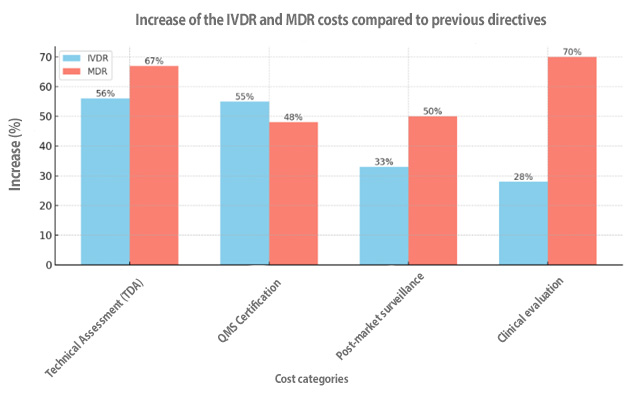
In particular, as far as the IVDR certification is concerned, the costs associated to the quality management system (QMS) and to the assessment of the technical documentation (TDA) have dramatically increased.
Compared to previous directives, these costs have significantly grown, rising well over 50%.
This increase is due to the needs to comply with a series of new procedures, controls and documental requirements as provided for by the regulation, requiring a greater commitment in terms of resources and time.
MDR Certification
As for the MDR certification, the cost increase is even more evident. Clinical evaluation, that is a central aspect for medical device approvals, has seen a 70% increase in the costs for manufacturers.
Such increase is linked not only to the need of conducting more complex and in-depth clinical studies , but also to the growing demand of data and scientific evidence to demonstrate the device safety and efficacy. Companies must invest more in research and information collection, which leads to a significant increase of operative costs.
Moreover, a relevant part of the total costs for this certification is for staff. Approx. 90% of these costs is intended for human resources, that are essential for the preparation and management of the regulatory documentation requested for the certification.
These resources must be highly qualified and fully dedicated to the management of bureaucratic procedures, and to the verification that all regulatory requirements are met. Consequently, companies must bear high costs to maintain and train qualified personnel, further increasing total expenses.
From the Directives to the Regulations
In brief, the transition from the directives to the regulations has had a significant impact on the cost management by companies, forcing them to allocate more resources to certification and regulatory documentation management. This change has made the management of certifications more complex and expensive, but also needed to ensure that medical devices remain safe and compliant with the new European standards.
A complex system: the certification timeline
IVDR and MDR provisions impose conformity standards that are much stricter, however, in spite of the increased complexity of the processes, it cannot be said that this has led to an improvement of the device quality.
One of the main problems concerns the certification timeline, that has become significantly longer.
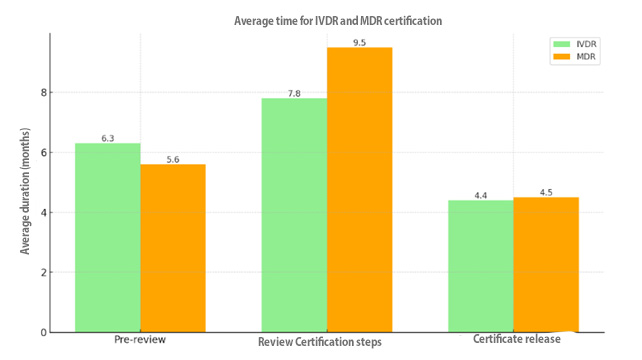
In particular, the process for the certification of IVDs requires 18 months on average, while MDs can take up to 22 months. A surprising aspect of this is that more than 50% of this time is dedicated to the preliminary steps and to the release of the certificate, rather than to the actual documentation review.
Moreover, the documental requirements are now wider. Manufacturers must provide detailed clinical tests and update post-market surveillance reports on a regular basis. This process has hugely increased companies’ administrative workload. Such additional task makes the management of documentation and, consequently, of the required corporate resources needed to comply with these new obligations, much more complex. Another factor further complicating the certification process is the interpretative divergence between the several notified bodies.
The different expectations and interpretations of the regulations create further uncertainty, and hinder a harmonised transition to the new regulatory framework. Companies find themselves in front of a great variety of approaches and interpretations, making difficult to get a certification that is consistent and harmonised all over Europe.
Optimisation and Reduction
The MedTech Europe report has stressed the need to optimise the certification process, reduce the costs and ensure more regulatory predictability.
Notified bodies use more than 50% of their time for the conformity assessment in other activities other than review, such as the pre-review and the certificate release.
Optimising the pre-submission step could reduce of more than 30% the total time for the conformity assessment. Moreover, the costs for the certification, the clinical evaluation and the post-market surveillance have significantly increased. Costs for the technical documentation (TDA) have doubled for more than a half of the IVD manufacturers, while the costs for the clinical evaluation have increased also for medical device manufacturers.
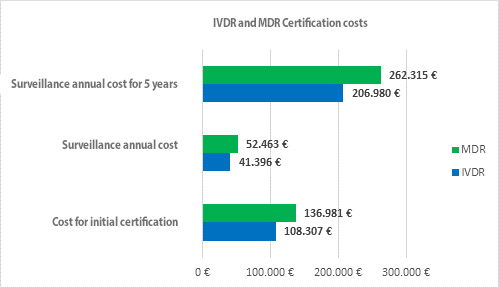
Another alarming aspect concerns the costs for surveillance and recertification: at the end of the 5-year certification cycle, IVD manufacturers will have spent approx. 70% more, while medical device manufacturers will have spent 50% more, not to mention the costs for the staff.
This increase, along with administrative inefficiency and complexity, puts to test the involved companies with no clear benefit for patients. The financial and regulatory burden could affect global markets depending on the European certification.

 Previous Post
 Next Post